A rather English pesto

IMG_20140718_150045These last two summers I have successfully grown watercress from seed in large tubs at home, starting the crop in the greenhouse and then moving it outside once the threat of a late Dorset frost has passed in May.  When I first mentioned to friends and family that I was experimenting with this tangy, peppery green leaf, there was much raising of eyebrows and several snorts of derision.  Watercress? In the garden of a country home? Doesn’t watercress need meadows and constant running water?

Well if my experience is anything to go by the answer to those questions is a resounding ‘NO’, but in the early stages I was inclined to think that these doubting Thomases might be right.  For weeks after sowing the seed nothing happened.  Finally a few specks of green appeared in the tubs, but I managed to convince myself that they were probably weeds.  By July, however, a healthy crop of strong-tasting watercress was flourishing and replacing itself quickly after initial pickings.  Admittedly my homegrown watercress does need constant watering, but this is a small price to pay for fresh, peppery salads, and the surprise on friends’ faces when presented with a pot of homegrown watercress pesto.  My 14-year-old daughter, chief pesto taster and aficionado, claims it to be the best pesto I’ve made and I make a lot, be assured.

My recipe is below.  We love to drizzle it over roasted salmon, but our most recent discovery is to boil a few new potatoes, toss them in a generous spoonful of watercress pesto, and top this mouthwatering mixture with a few freshly podded peas to finish.  This warm potato and pesto salad idea comes courtesy of my cousin Belinda who told me about her potato and mint pesto salad – another delicious, summer combo that we shall soon be trying.

Watercress Pesto

50g watercress, thick stalks removed
25g macadamia nuts, roughly chopped
20g pecorino romano, finely grated
1 clove garlic, crushed
A pinch of salt 100ml extra virgin olive oil

Place all the ingredients in a food processor and whizz on high speed for a few seconds to form a paste.  Stir in more olive oil if you like a slightly runnier consistency.

IMG_20140718_153807
IMG_20140724_214029

Wednesday’s Wine

altaviarosseseThe wines of Liguria are little known beyond its boundaries but local grapes like Rosesse (red) and Pigato (white and related to Vermentino) are well worth hunting out.  Picking up on a recent tweet from wine critic, Jamie Goode, who had tasted some Ligurian wines on sale in the UK, I was straight onto Red Squirrel Wine’s website to check out their range.   Not long afterwards, my order of Ligurian wines arrived here in Dorset, and very promptly too I might add – great service!

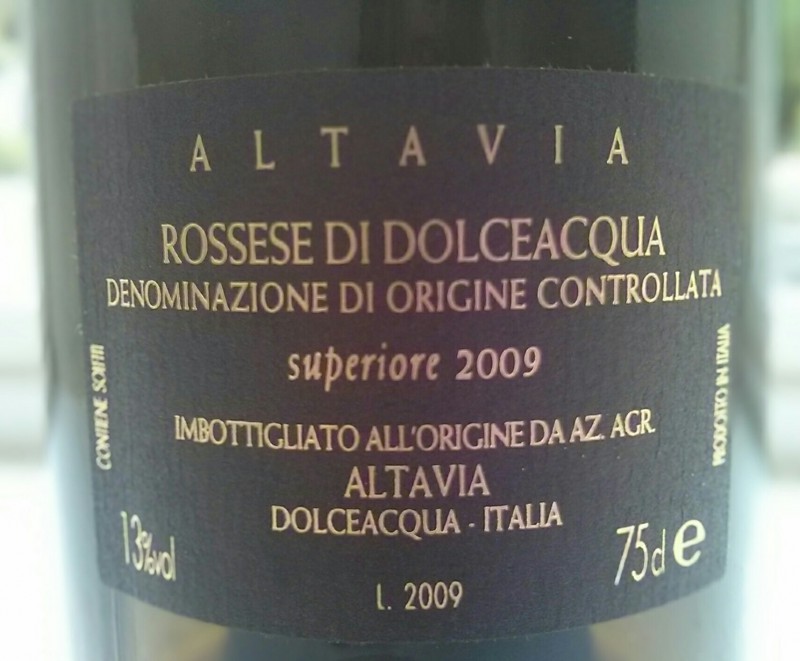
The Azienda Agricola Altavia is based in Dolceacqua in Western Liguria, a medieval village in the hills above Ventimiglia. Tonight’s wine is their Rossese di Dolceacqua Superiore 2009.  Rosesse has been grown in this area since it arrived from Provence, just over the border to the west.  It is grown almost nowhere else in the world, and is now thought of as the red grape of Liguria, giving wines that are deeply coloured and sometimes compared to Languedoc reds such as Minervois or Fitou. In a region that is dominated by aromatic, fresh white wines, it was good to try something a bit different – I can’t remember when I last drank a Ligurian red wine.  Maybe this is my first (of many I hope)?

The Altavia Rossese is bold, earthy and blackcurranty with bags of Mediterranean herb flavours and a savoury edge that worked well with our mushroom-based pasta supper.  The recipe for Tocco di Funghi, a mushroom sauce with a base of pine nuts, garlic and rosemary crushed in a mortar and pestle, from Fred Plotkin’s book ‘Recipes from Paradise’ was genuinely perfect for this unusual and distinctive wine.  Can’t wait to try Rosesse in situ when we visit the area in August.  Salute!

mushroomsaucepasta

Altavia Rossese di Dolceacqua Superiore 2009
We bought ours at Red Squirrel Wines – £14.99
The Azienda also has an online shop

Courgette Flower Fritters

CourgetteFlower2For the last few years we have successfully grown courgettes here in Dorset and I’ve enjoyed putting them to good use in many a Riviera-influenced recipe. This year, however, I have yet to harvest even one courgette from my three plants, but the beautiful, yellow courgette flowers have been prolific.

Ideas for stuffing this delicate crop abound and I have tried various concoctions including ricotta with herbs, pesto and even mozarella and anchovy.  But stuffing these beautiful blooms can be a fiddly business and sometimes all I want is something quick, easy and tasty for my current (almost) daily supply.

So here’s what I’ve come up with, using one of my favourite ingredients, chickpea flour.  Quick, easy and so moreish.

Chickpea Flour & Saffron Courgette Flower Fritters
(no stuffing)

20 courgette flowers, washed and dried
125g chickpea flour
175ml sparkling water
A pinch of salt
A pinch of saffron strands
Olive oil for frying

Make a batter by whisking together the flour, water, salt and saffron.

Heat the olive oil in a frying pan.

Coat the courgette flowers in the batter and drop them, a few at a time, into the oil.  Turn them over and then remove them from the pan once they are lightly browned and crisp.  Drain on kitchen towel and serve immediately.

A great canapé idea!

CourgetteFritters

Wednesday’s Wine

006

For our latest Wednesday wine, we’re hopping over the water from the Riviera to a jewel of the Med – the island of Corsica often referred to as L’Île de Beauté for its beautiful coastline, stunning harbours and rugged, mountainous interior.  Acquired by the French who bought it from the Genoese in the 1700s, its Italian heritage is still very much in evidence particularly in its cuisine and whilst all the locals speak French, the native language, Corsu is still spoken in rural areas and also in parts of northern Sardinia across the Strait of Bonifacio.

When it comes to wine, Corsica has a long history of viticulture which can be traced back to the Phoceans as long ago as 570BC.  Today, much of the wine produced is consumed on the island by the locals and the influx of tourists during the summer months.  Grape varieties are distinctly Italian in origin with Vermentino, also known locally as Malvoisie on the island, dominating for the whites.  Nielluccio, thought to be closely related to the Tuscan grape Sangiovese, and Sciacarello, a grape unique to the island, play an important part with the reds, although international grape varieties such as Syrah and Grenache are often blended with these varieties nowadays.  The first AOC was granted to Patrimonio in 1968 and today the island’s AOC count totals nine.

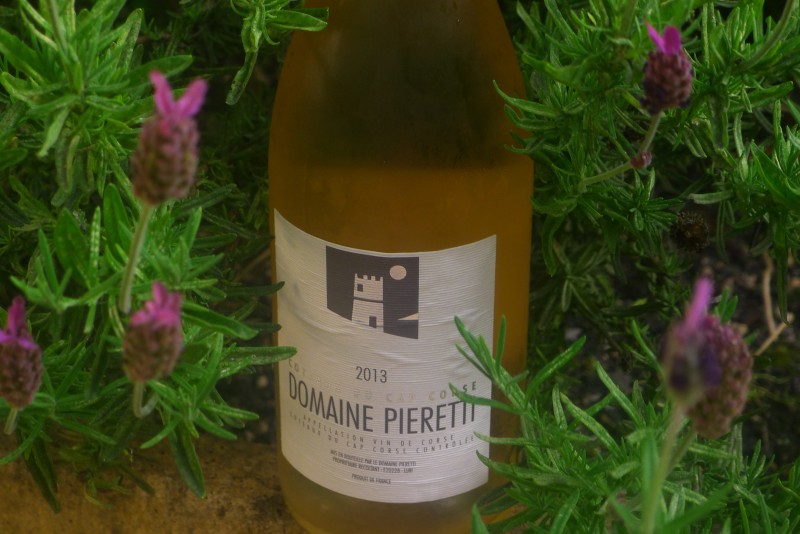
So, to our wine: in the north of the island on the Cap Corse, Lina Pieretti-Venturi, one of only a handful of female winemakers on the island with 5 acres of vines, produces the delightfully pale Domaine Pieretti rosé. We’re trying the 2013 vintage which is fresh, very dry and bursting with summer berry flavours and a real minerality which I love in a rosé.  It’s a blend made from another indigenous grape, Alicante, together with Nielluccio and a little Grenache, giving it sufficient backbone to pair with seafood dishes – our garlic and chilli prawn linguine worked a treat – but I would be just as happy drinking it unaccompanied.

014

Domaine Pieretti Rosé 2013 – Coteaux du Cap Corse
We bought ours at Yapp Brothers – £15.50

Les petits farcis

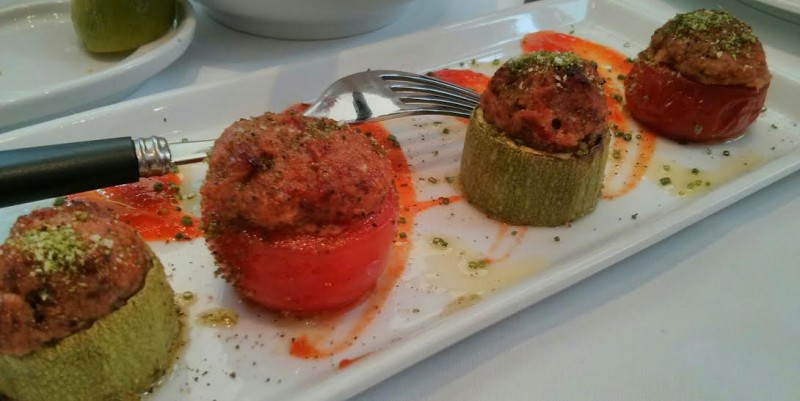
Petits Farcis Niçois at La Petite Maison, Mayfair, London.

Petits Farcis Niçois at La Petite Maison, Mayfair, London.

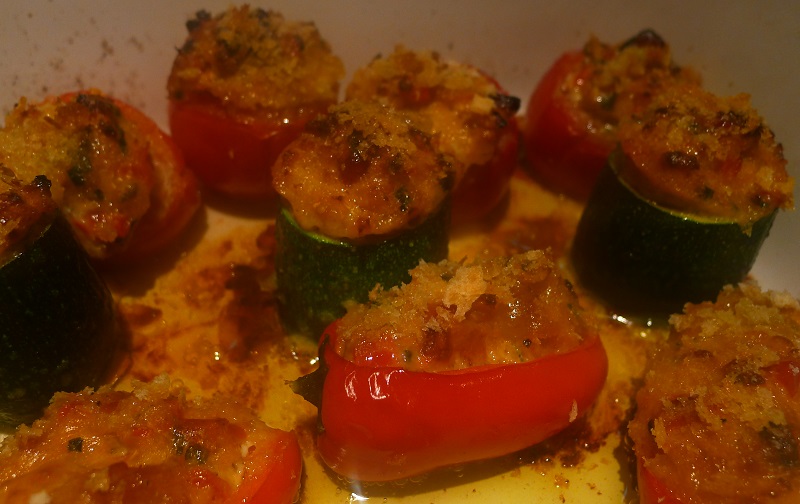
Back in April I spent an indulgent afternoon with a good friend sampling the tempting delights of La Petite Maison, a restaurant in London’s Mayfair which describes its cuisine thus: ‘combining the best fresh seasonal ingredients with the culinary influences of the Côte d’Azur and neighbouring Liguria’.  Popping up on the menu were so many Riviera favourites together with some iconic bottlings from the region, but my attention was immediately drawn to the Petits Farcis Niçois or stuffed vegetables, which I hadn’t tasted for years and had certainly never cooked myself.  These little bite-sized portions of courgette and tomato (see photo above) looked so dainty, and they were awakened by the strong flavours of the veal stuffing, the resulting ensemble melting slowly in the mouth.   I came away wanting to recreate this idea at home, and so began the research…..

Farcis, known as ripieni in Liguria are eaten all along the Riviera, but in usual local style thoughts on the stuffing ingredients vary from place to place.   The elements common to most recipes are garlic, herbs, eggs, the scooped-out flesh of the vegetables themselves and leftover meat (ham, beef, veal, pork or a blend of more than one, chopped up finely).  Some cooks add cheese, others rice.  I came across breadcrumbs and mushrooms too, but what seems clear from the text accompanying many of the recipes I looked up, is that here is another recipe demonstrating the creativity and frugality of the people of the area who have traditionally used up leftovers from yesterday’s lunch and blended them with the fresh produce available to them locally.

Mireille Johnson, writing in her book ‘Cuisine of the Sun’ explains the raison d’être of these delicious morsels so romantically:  “Farcis are a summer staple in Nice.  On Sundays and festive days housewives and children carry large trays of freshly stuff vegetables to the village baker’s oven, returning at noon to pick up their crisp, golden farcis.  Served at most picnics or buffets, farcis are usually prepared in large quantities, since they are delicious warm or cold”.  She also advises the use of small vegetables and the avoidance of over-stuffing them.

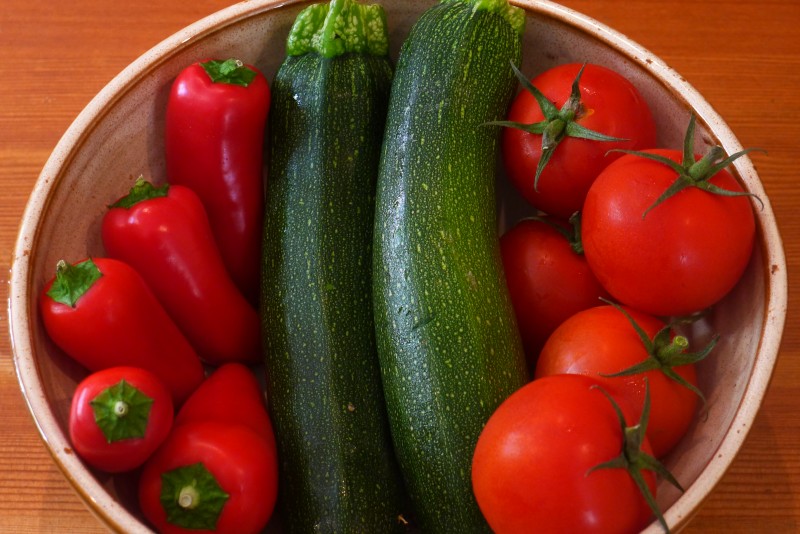
For my version of the dish, I used baby peppers, young courgettes and medium-sized vine tomatoes.  Served warm, the courgettes and peppers would make great canapés, the tomatoes would work better as a light lunch dish, with a green salad, as finger food they are not.  Bon appetit!

2419

Petits Farcis

1 medium-sized courgette (zucchini)
4 mini peppers
4 small to medium sized tomatoes
1/2 onion, finely chopped
20g breadcrumbs
2 cloves of garlic, crushed
30g finely chopped cooked meat (I used pancetta)
20g parmesan, finely grated
tbsp chopped fresh herbs (basil & sage for me)
1 large egg, beaten
salt and pepper to taste
Olive oil to

Chop the courgette into four rounds and scoop out the flesh, ensuring that a good base of flesh is left at the bottom so as to make a small cup shape. Slice the top off the tomatoes and scoop out the flesh and seeds. Cut a slice across the length of the pepper and clean out the inside.  Place the hollowed-out vegetables in a baking dish and drizzle with olive oil.

Chop and reserve the courgette flesh, tomato pulp and seeds. Chop the pepper ‘lid’ into small pieces and add to the courgette and tomato pulp.

Pre-heat the oven to 200°C.

Next, sauté the onion and pancetta in olive oil for 5 minutes on a medium heat stirring regularly.  Then add the crushed garlic with 15g of the breadcrumbs and stir for a further two minutes.  Add the reserved vegetable pulp and cook for another five minutes, stirring all the time.  Then add the fresh, chopped herbs and stir for a minute or so.

Remove the mixture from the heat, place in a small bowl. and stir in the grated parmesan.  Add salt and pepper to taste.  Finally, stir the beaten egg into the mixture.

Fill the hollowed vegetables with the mixture, sprinkle with the remaining breadcrumbs and drizzle with olive oil before placing in the pre-heated oven for 20-25 minutes uncovered.  The tops of the vegetables should be brown and crispy when you take them out of the oven.  Yummy.

2423

2428

2437

Wednesday’s Wine

IMG_20140617_133301Last weekend found us drinking some delicious and elegant white wines from Bellet and the Riviera Ligure di Ponente – watch this space for a post on Vermentino / Rolle / Pigato coming soon.  Midweek, however, we are looking for well-made, reasonably priced wines, so this week’s offering from Aix en Provence fits the bill perfectly.

Domaine des Oullières‘ Harmonie Blanc is a wine I’ve often picked up on the way out of Yapp Brothers, a specialist importer of French wines here in the UK, for whom I do the odd bit of work from time to time.  A blend of Rolle (aka Vermentino), Grenache Blanc and Ugni Blanc, it seems to tick the right boxes with many a journalist.  For me, the herb and pepper notes on the palate are key alongside a subtle tinge of orchard fruit.  It’s great to find a source of typical, well-made, but not over-priced white provençal wine like this one, and the Domaine makes a good rosé with the same ‘rapport qualité-prix’. We drank the white with a chilled courgette and basil soup on a balmy evening, and it is made for such local favourites as pissaladière, tapenade toasts or seafood stew. Looks like I’ll be buying another bottle to confirm and indulge in these most provençal of pairings.  Santé!

IMG_20140617_132748 (3)Domaine des Oullières Harmonie Blanc 2012 – Coteaux d’Aix en Provence
We bought ours at Yapp Brothers – £10.95
The Domaine also has an online shop

Pissaladière – tart or pizza?

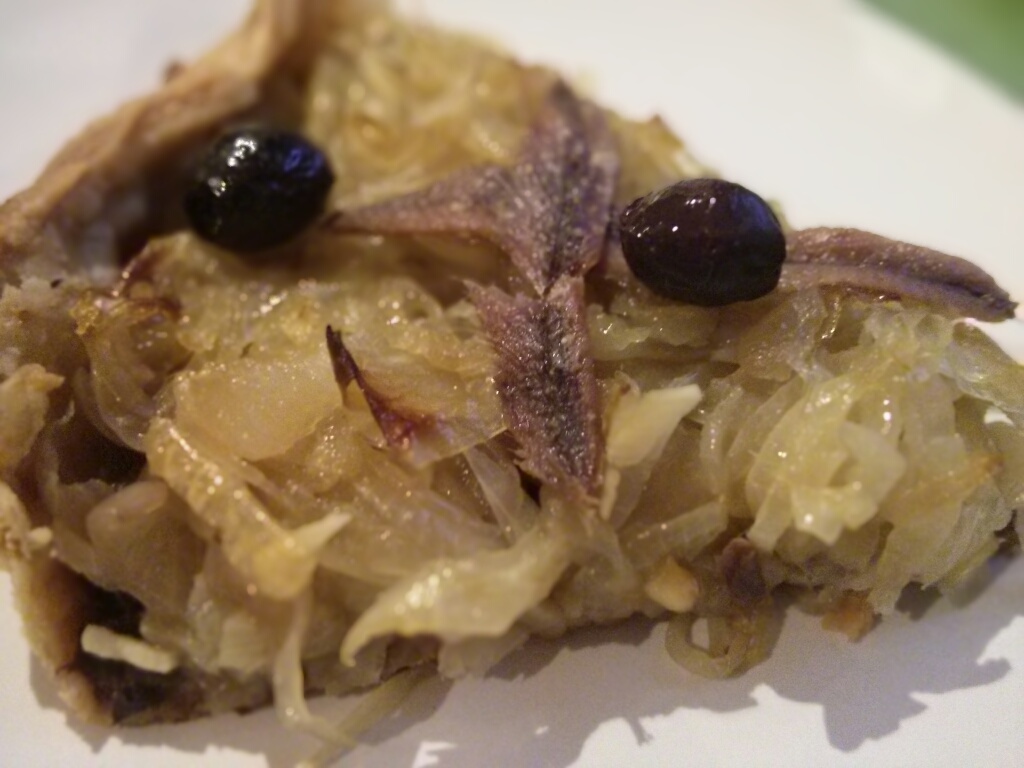
IMG_20140521_202541Caramelized onions, anchovies and olives – the key components of a pissaladière are never in question.  But as to whether this dish, popular on both sides of the French / Italian coastal border, should be made with a bread dough base similar to focaccia or with pastry is up for debate.  Having read around the subject it would seem that the former option is more widely accepted as the traditional recipe, but I beg to differ with popular opinion so you will find my recipe below, using pâte brisée.  The combination of the crumbly, crisp pastry with the melting onions and sharpness of the olives and anchovies is irresistible.  Another twist in my recipe is a thin layer of black olive paste which I spread over the tart base before ladling in the onions.

If you can resist, leave the tart to cool once cooked as you will find it at its very best eaten cold. Serve it with a chilled Vermentino or even a provençal rosé. And if you prefer a bread dough base, you could use the focaccia recipe I posted recently, omitting the rosemary.

Pissaladière

225g plain flour
125g unsalted butter, chilled & cut into small cubes
5g salt
1 egg yolk
30ml chilled water

100g pitted black olives + a few extra to decorate
20-30 ml extra virgin olive oil + extra for sweating the onions / decoration
2 sage leaves, roughly chopped
Small pinch chilli flakes

2 kgs white onions, finely sliced
4 bay leaves
A few sprigs of thyme
Tin of anchovy fillets in oil

Brush the base and sides of a loose-bottomed 30cm tart tin and prepare the pastry. Place the flour and salt in a bowl and rub in the cubes of butter with your hands until the mixture looks like breadcrumbs.  Add the egg yolk and water and work the ingredients together to form a soft dough.  Wrap the dough in clingfilm and leave it to rest in the fridge for 2 hours or overnight if you prefer.  When you take the pastry out, allow it to reach room temperature before rolling it out on a floured surface until it is around 5mm thick.  Place the pastry into the tin and press it in lightly with your hands. Prick the surface with a fork a few times, cover and leave in the fridge for half an hour.

Heat the oven to 200°C and then turn your attention to the onions.  Fry them on a low heat in a large frying pan with a swig of olive oil, the thyme and bay leaves, and leave them to cook gently for half an hour or more without browning.

When the oven is up to temperature, remove the pastry case from the fridge, cover the base with greaseproof paper and fill with baking beans.  Bake blind for ten minutes until the pastry is starting to crisp.  Remove from the oven and set aside.

In a small foodmixer, whizz up the black olives with 20-30 mls of extra virgin olive oil, the chilli flakes and the sage.

Once the onions are soft and sticky, take them off the heat and remove the bay leaves.  If there is a lot of liquid in the onion pan, pour that away. Spread the black olive mixture onto the bottom of the tart case, ladle in the onions and top with anchovy fillets and a few black olives. Drizzle with extra virgin olive oil and pop in the oven for 20 minutes at the same temperature as before.

IMG_20140521_205046

My mouth is watering just thinking about it.  Must make another one soon! I hope you enjoy it too.


Wednesday’s Wine

IMG_20140603_185659[1]Monday and Tuesday evenings are usually alcohol-free in our house so by Wednesday we are ready for a glass of something new and interesting to celebrate being halfway to the weekend.  If you follow my twitter feed, @pestopistou, you will have noted that yesterday (Tuesday) proved an exception to this rule, but you might also spot that this minor slip-up was made in the name of research for today’s first post in a forthcoming series of Wednesday’s Wine features.  We will aim to uncover some great wines from the Riviera and beyond with a smattering of wines from further afield if we’re travelling or spot something unusual that’s worth reporting on.

So to tonight’s wine: Gavi lies some 50km to the northwest of Genoa, just over the Ligurian border in Piedmont. The white wines from this area are from the Cortese grape and those made within the commune of Gavi itself can be labelled as Gavi di Gavi.  This Wednesday’s wine is from the Azienda Agricola La Toledana, a co-operative producing this intriguing single-estate bottling from late-harvested grapes which gives it an unusual weight and concentration. This extra punch sits well with the wine’s refreshing acidity, grapefruit and pear flavours and long, minerally finish. One we will most certainly be drinking again.

And to match?  We cooked up an asparagus speltotto (risotto made with pearled spelt rather than rice), generously dressed with pea shoot and mint pesto.  A perfect reward for making it to Wednesday.

IMG_20140603_202101Wednesday’s Wine
La Toledana Single Estate Gavi di Gavi 2012
We bought ours in the UK at Majestic – £11.99
For worldwide stockists, check http://www.winesearcher.com

Focaccia, fugassa or figassa?

IMG_20140521_133421

Focaccia is made all over Italy nowadays, and well beyond its borders too, but in Liguria “fugassa”  as it is known in the local dialect (figassa in Genoese) is widely available and enjoyed as a snack, often with a coffee mid-morning.  A thick, flatbread that is liberally dosed and doused with olive oil, it is most commonly served with an onion topping, thus resembling the French pissaladière.  Elizabeth David, writing in her book Italian Food, refers to focaccia as the ‘Genoese pizza’ but normally focaccia recipes include more yeast than for pizza, making the cooked dough thicker.

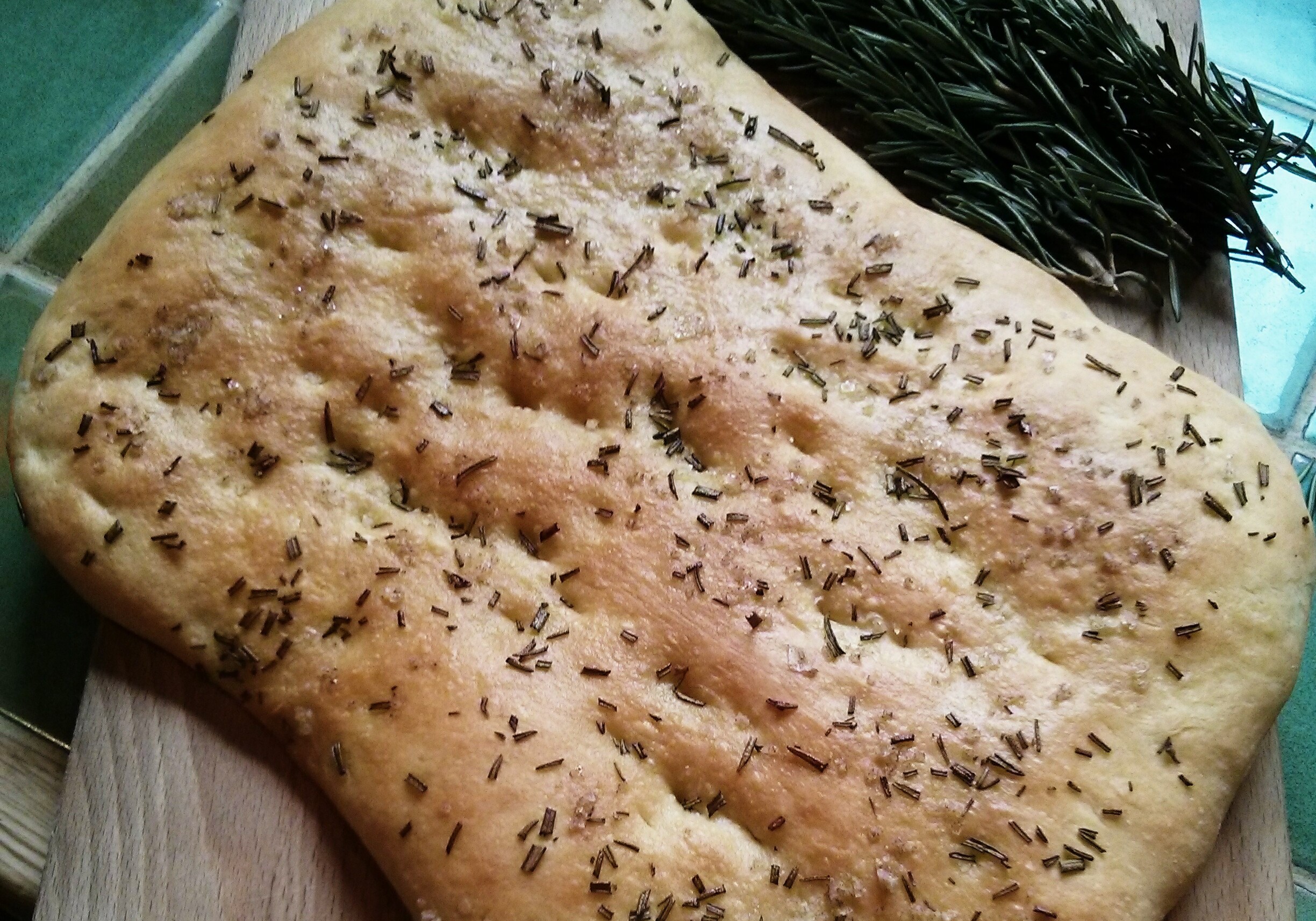
In the seaside town of Recco, the delicious focaccia col formaggio (cheese focaccia) is made by sandwiching dollops of the local soft, melting cheese, Crescenza, between two sheets of dough and baking until the top is golden brown.  Another popular version of the bread, focaccia col rosmarino, originally thought to have been created to attract the tourists, is studded with rosemary or other herbs, sprinkled with coarse sea salt and simply oozes with olive oil.  You’ll find the recipe for this last focaccia below and I can promise you it’s a real crowd-pleaser and will have everyone eating more than they really ought to so here’s a useful tip: make plenty.

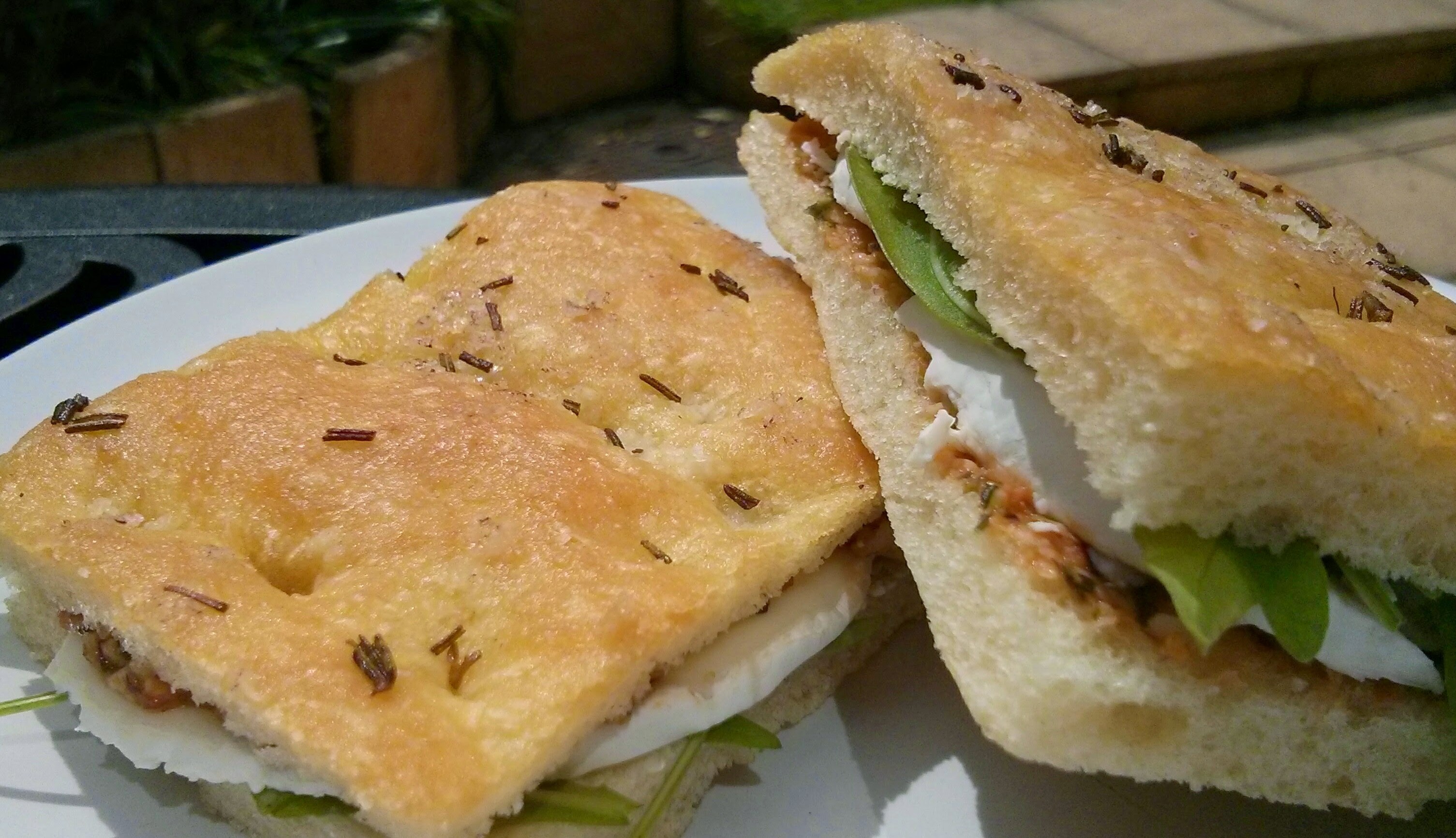
I like to serve the rosemary focaccia warm with a selection of charcuterie, artichokes in olive oil and a salad of ripe tomatoes.  Or perhaps a ball of gooey Burrata cheese.  If there is any left the next day (a rare sight in my house), try toasting it and serving simply with unsalted butter or a slug of olive oil and some chopped tomatoes. Given the thickness of the bread, it’s great for sandwiches – just slice it in two and fill with tapenade or pesto, sliced tomatoes and goat’s cheese.

IMG_20140521_133549

If you happen to be in Recco on Sunday 1st June this year, look out for La Festa della Focaccia di Recco, a local festival celebrating this local culinary icon.  More info here: www.focacciadirecco.it

Rosemary Focaccia
(makes two loaves, each measuring roughly 12cm x 30cm)

500g strong white bread flour
10g fast-action yeast
120ml extra virgin olive oil plus more for brushing the top of the bread
275ml warm water
10g fine salt
Coarse sea salt for sprinkling
A few sprigs of fresh rosemary

Mix the flour, yeast and salt then add the olive oil and water.  Knead the mixture on a floured board for up to ten minutes by which time the dough should be smooth and elastic.  You can also use a food processor with a dough hook for this.  If the dough is very sticky, add a little more flour.

Form the dough into a ball and leave in an oiled bowl, covered with plastic film, for an hour until it has at least doubled in size.

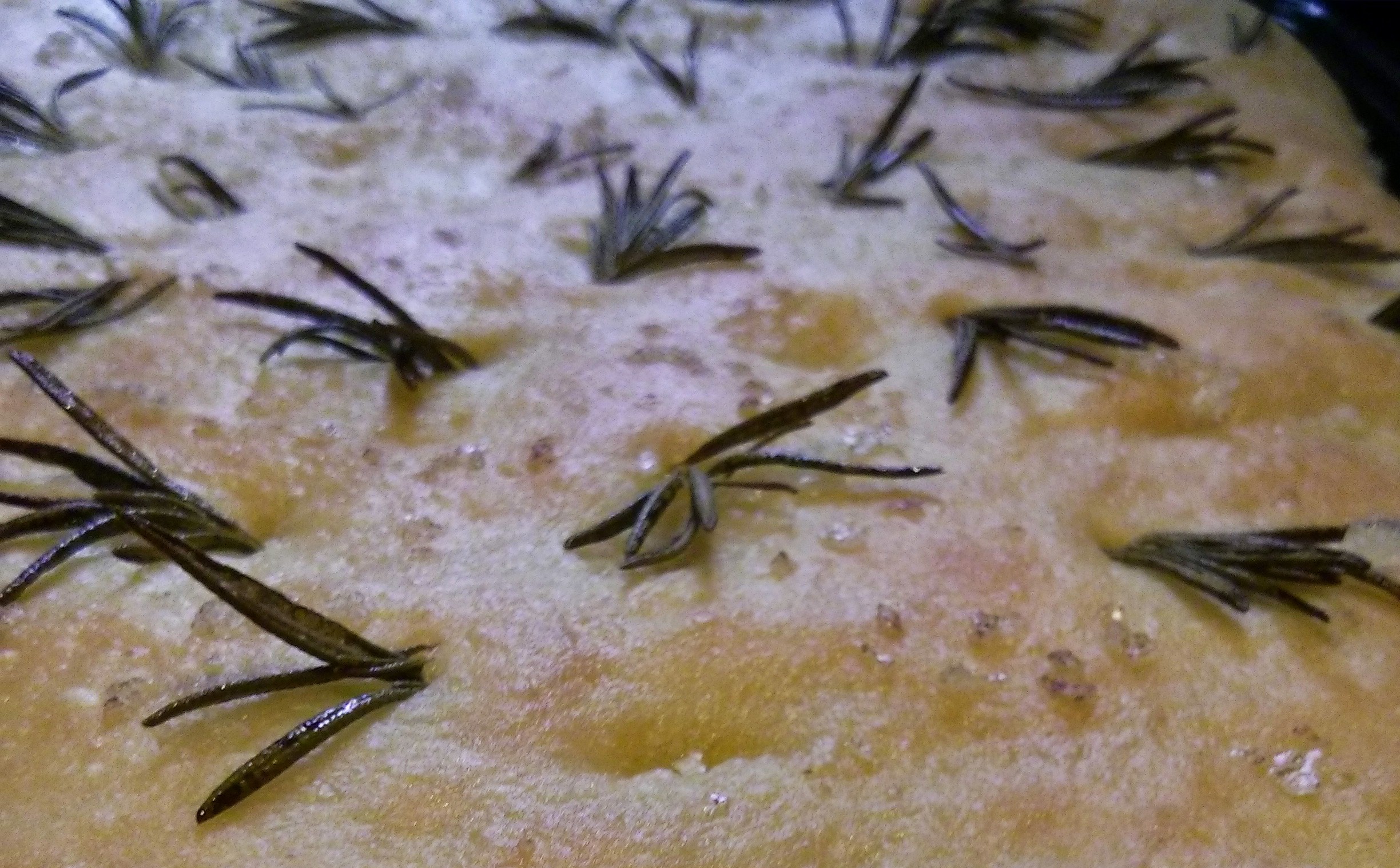
Heat your oven to 220°C and oil two 12cm x 30cm baking trays.  Take the dough from the bowl, cut into two pieces and mould both pieces into oval shapes to fit the baking trays.  Use your knuckles or fingertips to make slight indentations all over the dough.  Brush it with extra virgin olive oil and stud it with rosemary leaves (you can chop them finely first if you prefer), and press them into the dough.  Sprinkle with the coarse sea salt and drizzle with more olive oil.

Leave the dough to rise in a warm place for half an hour then bake in the middle of the preheated oven for 10-15 minutes or until golden brown – keep an eye on it as it can turn brown suddenly and will easily overcook and become too hard.

Take the bread from the oven and place on a wire rack for a few minutes.  Drizzle with more olive oil and serve.


IMG_20140520_141510


IMG_20140520_142750


IMG_20140520_150830


Socca Chips (Panisses / Panizzie)

socc_main

One of our rituals on a visit to Nice is a wander down the winding, narrow streets of the Old Town in search of a plate of socca.  Known as farinata across the Italian border, socca is a thick pancake made from chickpea flour and in Vieux Nice it’s great fun to see it being deftly cooked in the street in large, flat pans.  Once it’s ready, this delicious street food is roughly cut and sprinkled generously with black pepper (essential).

As with all things culinary in this part of the world, there are endless arguments about the correct ratio of chickpea flour to water and many people believe it is not a recipe to be cooked at home but one to be brought back to the house as a takeaway.  I tend to agree as it’s not easy to produce something as good as what’s on offer in Vieux Nice so maybe it’s one of those local specialities that should only be enjoyed in situ.

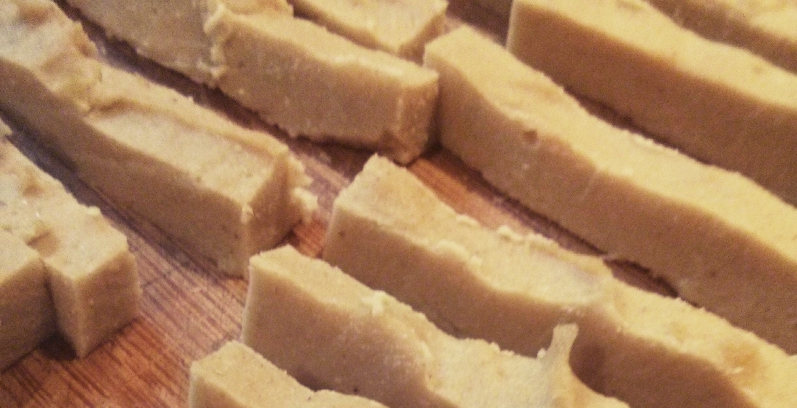
Socca chips however are an entirely different matter and my family go mad for them.  These little chickpea flour fries are called panisse in Nice and panizzie in Western Liguria where they are also made.  Simply make a thick chickpea flour paste, leave it to cool, slice the mixture into batons and fry these batons in olive oil.  I like to add a little grated cheese and some cumin to the batter, ideas pinched from Hilary Davis’ recently published book ‘Cuisine Niçoise’.  Serve the chips on their own as a snack or a hearty canapé with the obligatory twist of the black pepper mill and a pinch of sea salt.

Socca Chips

175g chickpea flour
1 ½ tsps ground cumin
1 ½ tbsps extra virgin olive oil plus extra for frying
25g gruyere cheese
675ml water
Pinch sea salt

flour

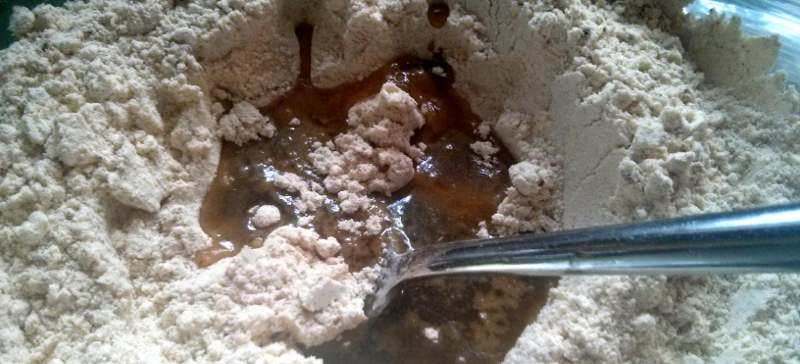
Whisk the above ingredients together in a large bowl, then transfer to a heavy-based saucepan and heat until thick, stirring constantly.  This should take about five minutes.

Pour the thickened mixture into a greased baking tray and leave to cool.  I use a 22cm square tin which gives quite thin chips. Cut the mixture into slices and fry in olive oil until crisp and browned on the outside.

Serve the chips straight away with salt and pepper sprinkled over them as desired.

socca_raw